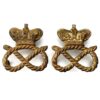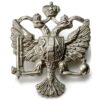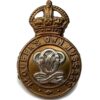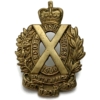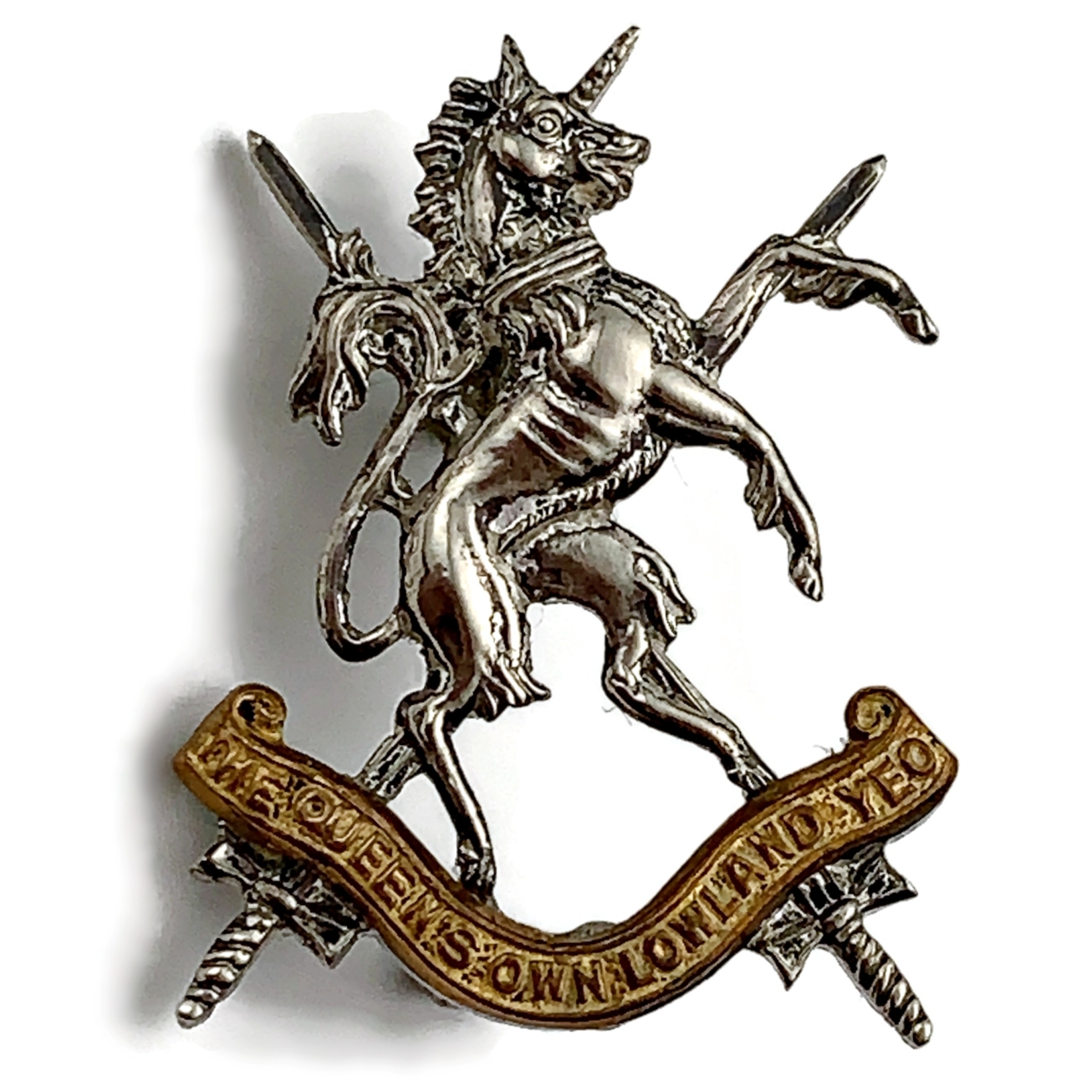
Guaranteed original. Complete & intact. This is an original The Queens Own Lowland Yeomanry Regiment Scottish collar badge for sale. In good condition. Please see our other items for more original WW1, WW2 & post war British military badges for sale including other The Queens Own Lowland Yeomanry Regiment Scottish collar badges.
For more original collar badges for sale, click here.
The Queen’s Own Lowland Yeomanry: History, Badge, and Insignia
The Queen’s Own Lowland Yeomanry (QOLY) was a Scottish yeomanry regiment of the British Army with a proud heritage rooted in the volunteer cavalry tradition. Formed in 1908 as part of the Haldane Reforms, the regiment resulted from the amalgamation of the Ayrshire Yeomanry and the Lanarkshire Yeomanry, both of which traced their origins to the late eighteenth century during the period of the French Revolutionary and Napoleonic Wars. From its inception, the regiment embodied the ethos of the citizen-soldier, combining local identity with national service.
First World War Service
At the outbreak of the First World War, the Queen’s Own Lowland Yeomanry was mobilised for overseas service. Initially trained as mounted cavalry, the regiment was soon deployed as infantry due to the realities of modern warfare. Attached to the 52nd (Lowland) Division, the QOLY served with distinction during the Gallipoli Campaign in 1915, where it endured extreme conditions and heavy casualties. After Gallipoli, the regiment fought in Egypt and Palestine, taking part in key actions against Ottoman forces and contributing to the Allied advance that culminated in the capture of Jerusalem in 1917.
Inter-War Years and Second World War
Following the war, the regiment was reconstituted in the Territorial Army and underwent mechanisation, reflecting the decline of traditional cavalry. By the outbreak of the Second World War, the Queen’s Own Lowland Yeomanry had been converted into an armoured regiment. It served in the North African Campaign, playing a role in the desert war against Axis forces, before later elements saw service in Italy and North-West Europe, supporting the Allied advance after D-Day.
Badge and Insignia: Design and Symbolism
The cap badge of the Queen’s Own Lowland Yeomanry was rich in symbolism and reflected both royal patronage and regional identity. The badge prominently featured the Thistle, the national emblem of Scotland, signifying the regiment’s Lowland heritage. At its centre was a Royal Cypher surmounted by a crown, denoting the regiment’s title “Queen’s Own” and its association with the reigning monarch.
Surrounding the central device was a circular strap or garter bearing the regiment’s title, a common yeomanry design element that emphasised unity and continuity. The use of the crown evolved over time to reflect the reigning sovereign, with the King’s Crown and later the Queen’s Crown appearing in different periods. Collar badges and shoulder titles echoed the cap badge design, ensuring a consistent regimental identity across uniforms.
The regiment also wore distinctive armoured formation signs during the Second World War, linking it visually to the units and divisions with which it served, while still preserving its unique yeomanry traditions.
Legacy
In 1956, the Queen’s Own Lowland Yeomanry was amalgamated into the Queen’s Own Yeomanry (Lowlanders), ending its independent existence. However, its history, battle honours, and badge traditions continue to be preserved by successor units and regimental associations. Today, the Queen’s Own Lowland Yeomanry is remembered for its adaptability, regional pride, and enduring contribution to British military history.
Please see our other items for more original WW1, WW2 & post war British military badges for sale including other The Queens Own Lowland Yeomanry Regiment Scottish collar badges.